
Did he REALLY understand?
A few anti-Masons are quick to announce that a great religious leader, the Rev. Charles Finney, has been vocal against Freemasonry. They don't often mention at the outset, however, that he has been dead for more than a hundred and twenty five years - nor do they recognize that pride cometh before the fall....
Charles Grandison Finney (1792-1875) was a flamboyant evangelist of the "Second
Great Awakening" - a religious revival - in the United States. He served as the second President of
Oberlin College in Ohio (1851-65).
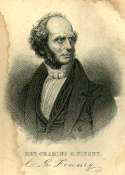
In 1821 in Adams, New York, (approximately 100 miles from Batavia where the Morgan Affair occurred just 5 years later), Finney had a dramatic religious conversion that altered the course of his life. Abandoning the practice of law, he began preaching the Christian gospel. When he was ordained, he agreed that he fully supported the Presbyterian denomination's credo, the Westminister Confession of Faith. It was later found that at the time, he hadn't even read it!
For nearly a decade, from 1824 to 1833, Finney conducted unusual revivals in the Middle and Eastern states and anti-Masons who seek to use him as a great spokesman for their cause claim that he saved some 500,000 souls. It should be noted that Rev. Finney advised his preaching brethren to try "new measures to stir up emotional excitements". Could it be that his attack on Freemasonry was one such measure?
Timely objections
Reverend Finney is one of those who was a Freemason and then, upon his conversion to Christianity, suddenly determined that his new-found faith and Masonry were incompatible. Rev. Finney supposedly renounced his membership in the fraternity immediately after his conversion yet it was some 48 years later that he spoke out by publishing (in 1869) "The Character, Claims, and Practical Workings of Freemasonry" attacking the order of which he had once been a member. He must have been awfully consumed by his hatred of the Craft to have taken nearly 5 decades - or was it that he was trying to reclaim the limelight and garner some profit from publishing on a subject that would produce book sales?
By contrast, his Lectures on Systematic Theology were published in 1846 and 1847 and among his other works are: Sermons on Important Subjects (3rd ed., 1836); Lectures to Professing Christians (1837); and Skeletons of a Course of Theological Lectures (1840). In 1867, Finney began writing Memoirs of Rev. Charles G. Finney. Edited by James Harris Fairchild and published in 1876, the memoirs deal chiefly with his evangelistic activities; they do not constitute an autobiography. Finney taught up until his eighty-third year, submitting his resignation from the presidency of Oberlin College in 1865. He died in Oberlin, Ohio in August 1875 following a heart ailment.
At the time Finney proclaimed his distaste for Freemasonry, other religious leaders were supporting it strongly.

What others say
There are many who find fault with Finney's theological assumptions. This one, for example, casts aspersion on his entire 'ministry'. We call it to your attention for reference purposes: please make your own decisions as to whether its condemnation is motivated by a theological argument or if the facts presented are valid.
|
Related Topics: |
|
In addition, |








 Just
click on "Prince, the Search Dog" to find things on our site. He's on every page
and he'll take you directly to our search form where you can see if we've
written about whatever it is you're interested in. Prince has a great memory; he
always remembers where things are!
Just
click on "Prince, the Search Dog" to find things on our site. He's on every page
and he'll take you directly to our search form where you can see if we've
written about whatever it is you're interested in. Prince has a great memory; he
always remembers where things are!