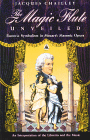
 The Magic Flute Unveiled
Esoteric Symbolism in Mozart's Masonic Opera
Jacques Chailley
Review by Ed King
I'm a person who enjoys most any kind of music. Playing or listening, I'm comfortable with marches or reggae. There's one exception: opera. Like many, I find it difficult (if not impossible) to understand and/or appreciate. With that in mind, I was prepared for a long and dreary reading. What I found in this book met my expectation with much detail of interest only to erstwhile opera lovers but what was also there was considerable, interesting detail about matters Masonic in 1700s Continental Freemasonry. In short, don't overlook this book just because you're not an opera aficionado!
This book is not a 'light read' by any stretch of imagination. Its orientation is directed towards opera buffs. Readers who'd hoped for a biography of Mozart and his Masonic connections will be greatly disappointed. Fans of this opera, however, will find a treasure-trove of detailed explanation which will (hopefully) add to their understanding of a convoluted and confusing but rich and powerful work with some of the best musical scoring of all time.
Jacques Chailley is not a Mason but he has filled this work with detail of the type one normally finds only in works of Masonic history written by Masons for Masons. American readers of this work will likely think that Chailley has gone beyond the bounds of reason when he ascribes certain things to 'Masonic influence' but Masons on the Continent will likely react differently. The subtleties of symbolism are treated with respect and understanding and the author is careful to substantiate his conclusions.
As just one sample of the author's thoroughness, he notes a 1911 work wherein an author had "...tried to make of Mozart, among many others, not only the regular Mason that everyone knows him to have been, but also an adept of Illuminism; that thesis has been repeated often since then. Mozart's supposed entry into Illuminism would have occurred will before his regular initiation in 1784, and that would explain the abundance of the somewhat "para-Masonic" works which he composed before that event. This thesis seems to have been received with skepticism in well-informed circles. Having no competence to judge it, I limit myself to mentioning it without expressing an opinion. I am, however, very much inclined to share the skepticism. Koch's book seems not to be scholarly in its handling of information." It's this type of writing which endeared me to this work and although I'm poorly equipped to judge whether Chailley has properly applied the appropriate symbolism to various pieces of this opera, he certainly seems to have 'done his homework'.
Of interest to students of Masonic history; of great interest to those who love opera and this opera in particular. (See below for a GREAT DVD of this opera - in ENGLISH!)

Some further information
 Since writing our initial review, we received an e-mail from a Mason who
was a music history professor for many years. He tells us that Chailley is a
highly respected author in the field of music and feels this work is highly
readable. He has encouraged me to try listening to "Magic Flute" with
these suggestions:
Since writing our initial review, we received an e-mail from a Mason who
was a music history professor for many years. He tells us that Chailley is a
highly respected author in the field of music and feels this work is highly
readable. He has encouraged me to try listening to "Magic Flute" with
these suggestions:
"Read the libretto first, of course (as you should always do before listening to an opera, even one in your native tongue). Then, bearing the story and the symbolism in mind, give it a try. It's wonderful: often very funny, sometimes scary, almost always moving. And in the final scene, who ya gonna trust? Sarastro of the Queen of the Night?"
He advises that there are a number of really superb performances of this work available at reasonable prices. I suggested that I might immerse myself in this during summer vacation at a lakeside cottage in Vermont. He replied:
"I suspect you'll be amazed at how really accessible this particular opera is. It doesn't take anything more than an open mind and time to understand its fundamentals. To understand it completely would, however, take several lifetimes. That's why I love it so much -- there's just layer upon layer. Most folks agree it's Bro. Wolfgang's operatic masterpiece, and, in fact, one of the greatest operas every written. Even better for Mozart, it was a real commercial success, although he was so close to dying that it didn't do him much good financially."
Our thanks to Brother John Klaus of Mt. Vernon, Iowa, USA for providing us
with this additional information and encouragement. He swears that he'll
make an opera lover out of me yet....
SEEING MOZART!
I'd read books trying to simplify one's understanding of opera and I'd followed the instructions above but NOTHING could compare to seeing the Metropolitan Opera's performance directed by Julie Taymor. There are lots of other performances around and others by the Met but THIS is THE ONE that you should watch. It's in ENGLISH and the scenery is astounding. It will allow you UNDERSTAND this opera - even if you don't like opera or have never seen one. The Met doesn't sell this DVD: apparently there's some sort of dispute but I ordered mine from a third party on Amazon and couldn't have been more pleased. If this sounds enthusiastic or gushy, it's because this REALLY is an excellent piece to see. You'll drag the whole family in to watch and it's likely you'll watch it several times. Believe me: it's worth the investment! GET IT!!!
And for some more interesting information on this topic, point your browser to the Indiana Masons Online site where you'll find a nice summary of biographical and Masonic information regarding Brother Mozart.






 Just
click on "Prince, the Search Dog" to find things on our site. He's on every page
and he'll take you directly to our search form where you can see if we've
written about whatever it is you're interested in. Prince has a great memory; he
always remembers where things are!
Just
click on "Prince, the Search Dog" to find things on our site. He's on every page
and he'll take you directly to our search form where you can see if we've
written about whatever it is you're interested in. Prince has a great memory; he
always remembers where things are!